|
|
|
|
|
ValidPIC: Electric Propulsion : Radio Frequency Ion Thrusters |
|
|
|
|
|
|
|
|
|
|
Ion propulsion systems with a small thrust can be used in space missions for
highly accurate controllability while possessing low power and propellant
consumption. At the University of Giessen, radio-frequency ion thrusters are
miniaturized with thrusts in the order of micro-Newtons (μN-RIT). As the
size of the thruster becomes smaller, the plasma properties can not be measured
inside a closed plasma chamber. The simulations are needed to investigate plasma
properties like temperature, density pro- file which would aid further
opimization. The kinetic simulations of plasma inside the RIT-1.0 thruster
using in-house developed PlasmaPIC code that incorporates Monte-Carlo collisions
(MCC) and Direct Simulation Monte Carlo (DSMC) for neutral gas distribution.
For the RIT-2.5 an one size bigger thruster we have developed Kinetic-Fluid
Particle In Cell model.
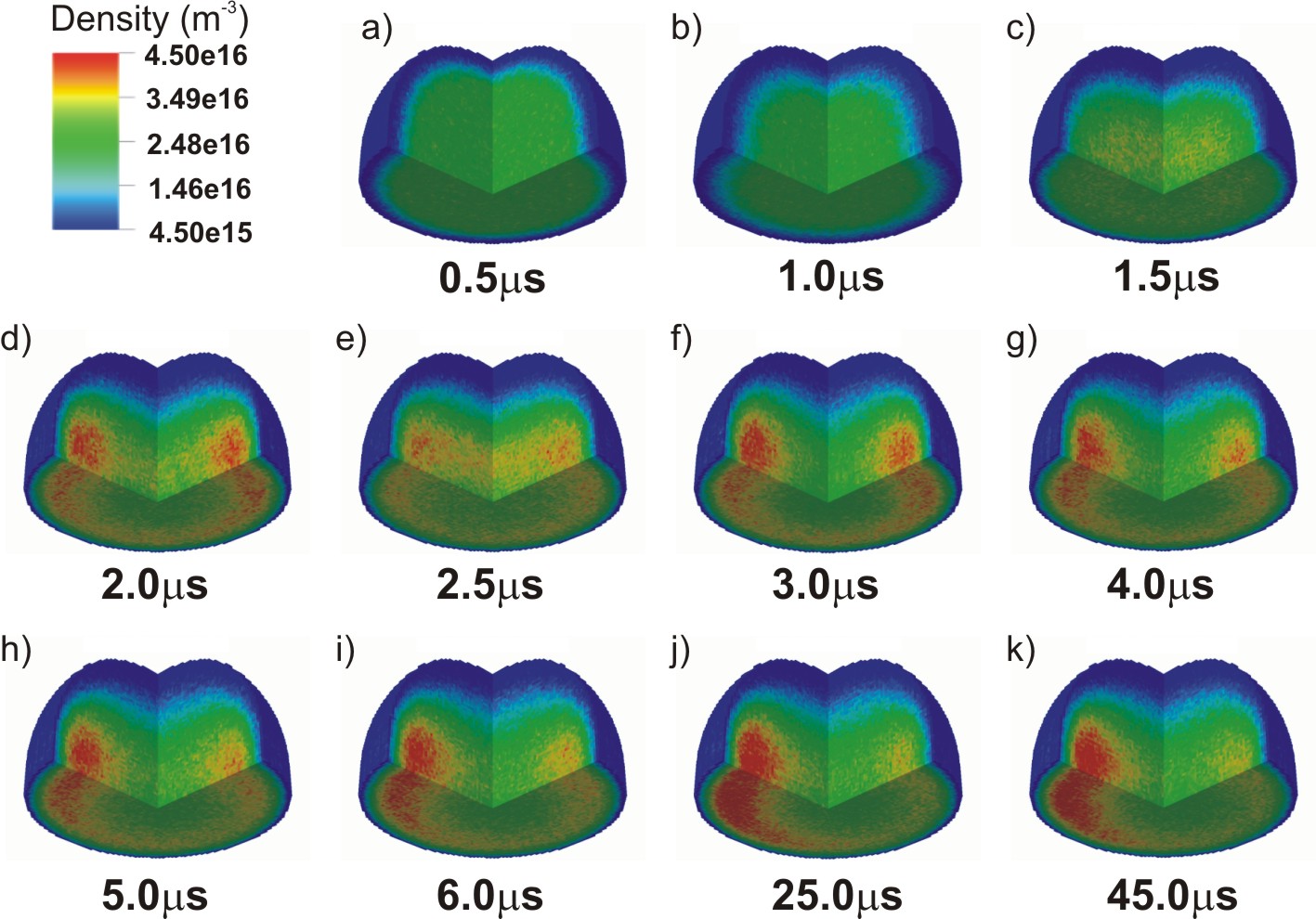
Plasma simulation inside RIT-1.0 showing ion density evolution.
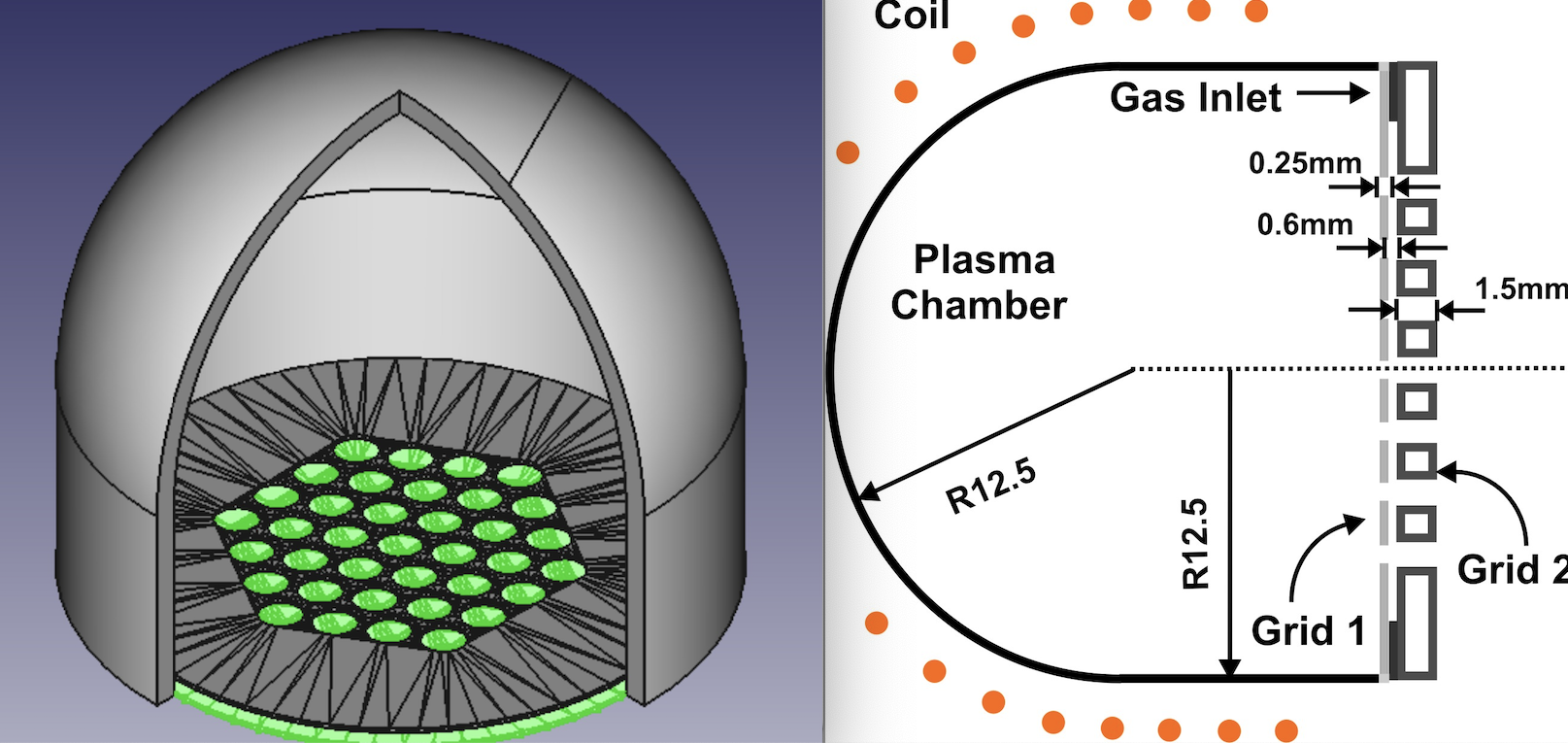
CAD model and 2d drawing of RIT-2.5
|
|
|
|
|
|
|
|
|
|
|
|
|
|
|
|
Cyclotron Gas Stopper |
|
|
|
|
|
|
|
|
|
|
At NSCL/MSU, I worked on the gas stopper project working on the principle
of reverse cyclotron concept. The new system is based on slowing down the fast ions
in a sector-focusing cyclotron magnet in a chamber filled with Helium buffer gas
at low pressure (up to 150 mbar). RF-guiding techniques are used to extract the ions.
During the postdoctoral work I used and modified this code to evaluate and optimize
acceptance of the machine for different ions. It was used to design injection channel.
The relativistic mover was implemented using Boris method. The beam envelopes were
calculated to help design vacuum vessel. The beam optics calculation for beam passing
through the A1900 separator was done using combination of two well known codes TRANSPORT
and LISE++. The beam emittances were matched to the calculated acceptances.
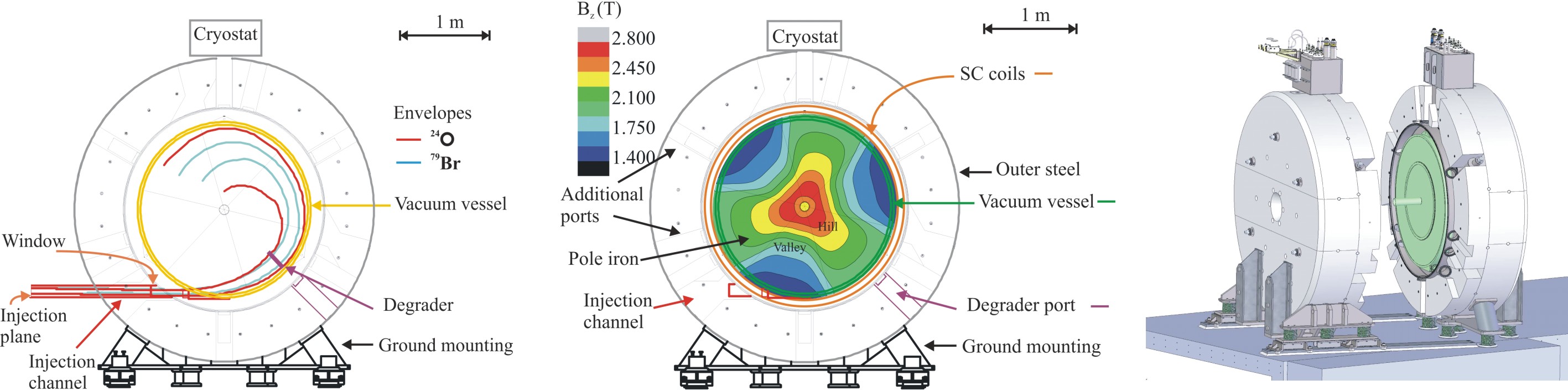
Simulation of beam envelope in stopping cell, Magnetic field map,
CAD drawing of CycStopper
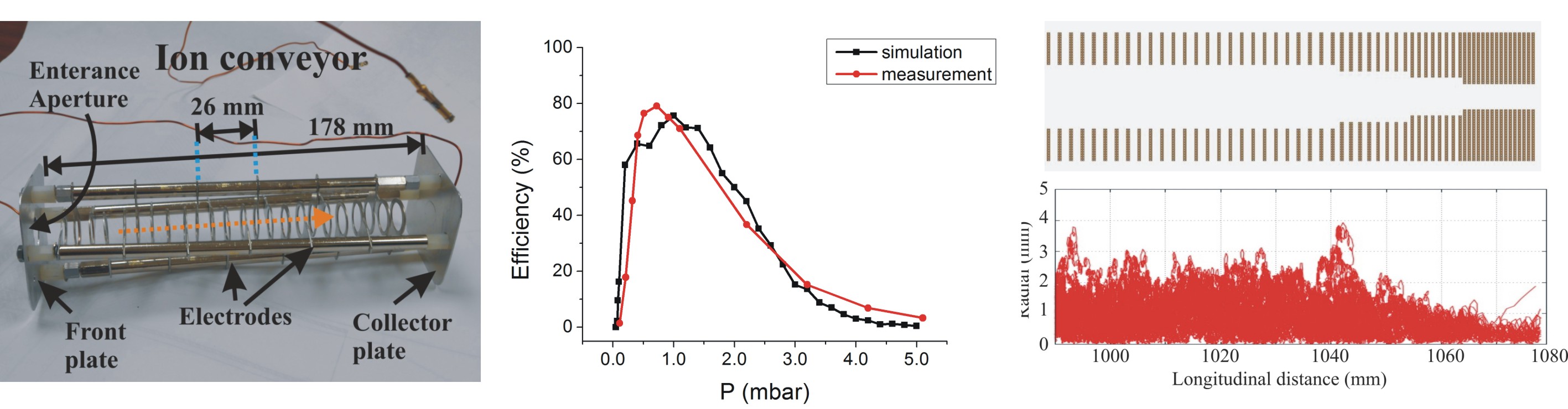
Handmade prototype of Ion Conveyor, Simulation comparison with measurement,
funnel type ion conveyor
|
|
|
|
|
|
|
|
|
|
|
|
|
|
|
|
Frankfurter Neutron Source (FRANZ) |
|
|
|
|
|
|
|
|
|
|
Intense neutron source for experiments in accelerator physics, astrophysics
and material science research is under construction at Stern Gerlach centre
of Goethe University at Frankfurt am Main. I worked on this project to simulate
beam transport through chopper system. I simulated space charge effects using
Particle-in- Cell method. The numerical model includes simulation of production
of secondary electrons and its effect on the pulse, simultaneous transport of
multiple ion species, and effects on bunch shape from kicker pulse. A test
experimental setup was also used to verify simulations which showed the space
charge compensation through secondary electrons produced at beam dump.
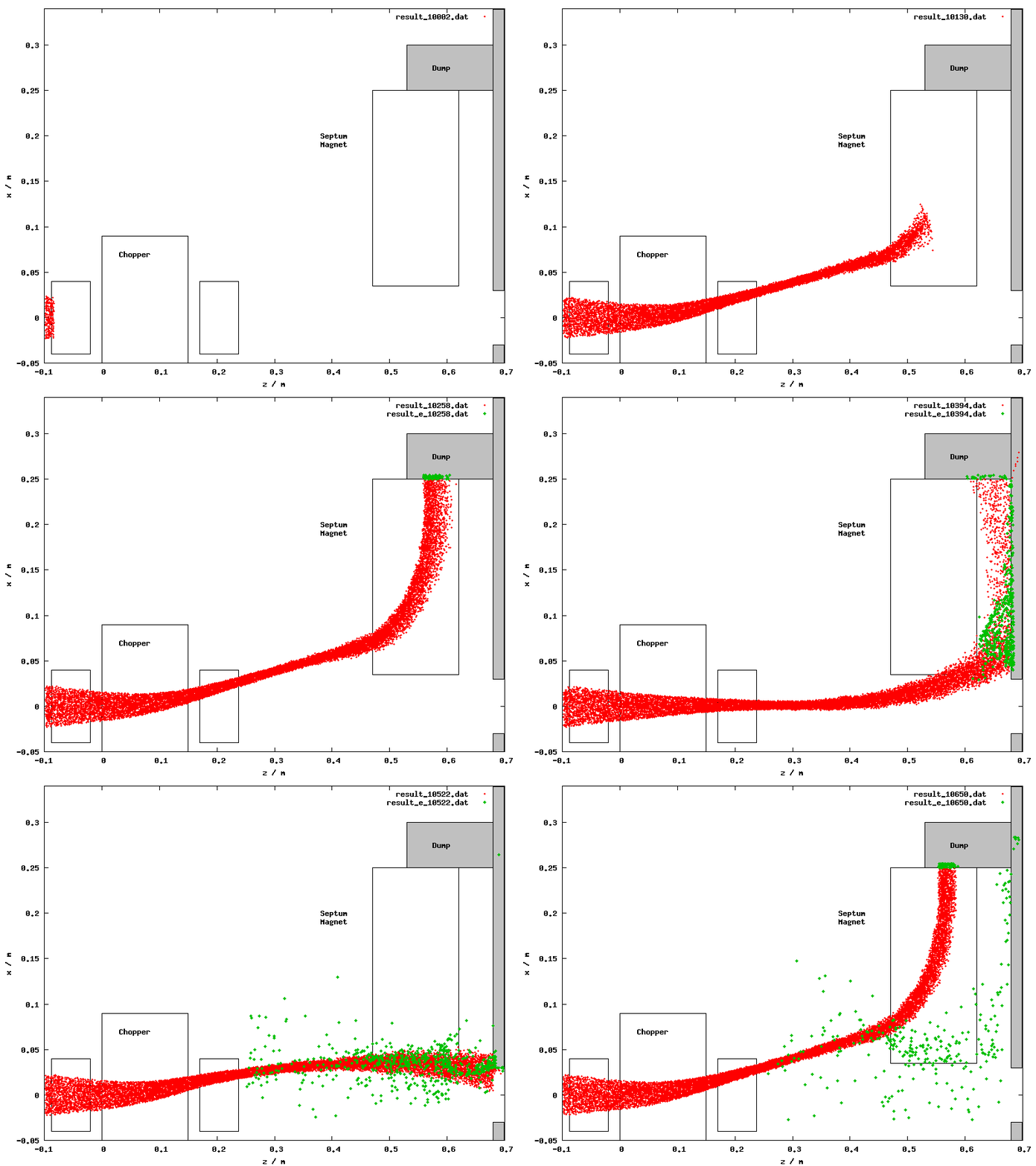
EXB Kicker; Red dots represent protons, green one the electrons
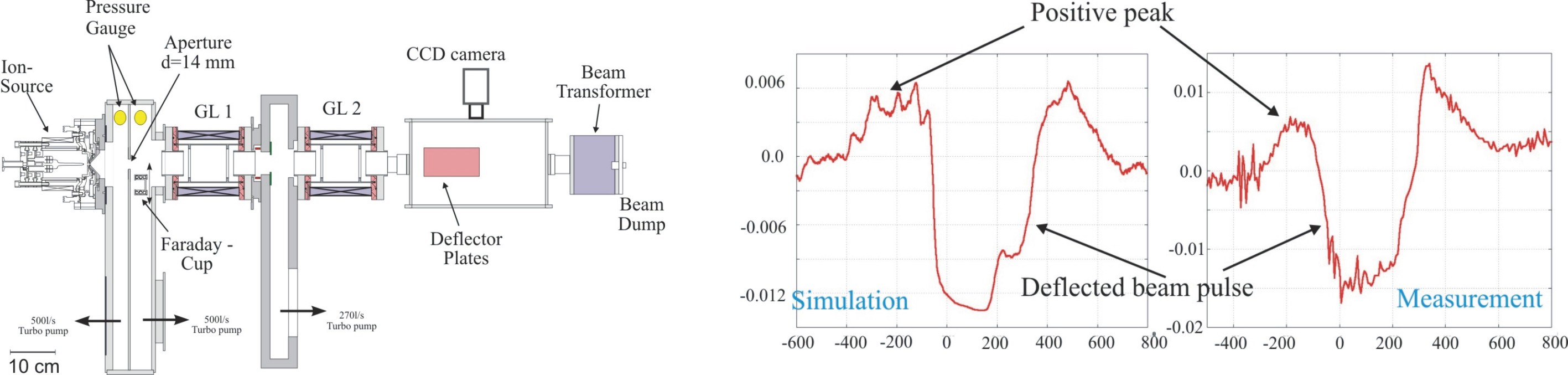
Left: Experimental Setup for electrical kicker,
Right: Simulation and measurements compared
|
|
|
|
|
|
|
|
|
|
|
|
|
|
|
|
F8SR - Stellarator-type Figure-8 Storage Ring |
|
|
|
|
|
|
|
|
|
|
My doctoral work was investigations on transport and storage of the high current
ion beams. A storage ring with a longitudinal magnetic field was proposed for
accumulation of intense ion beams. I developed numerical model using Particle-in-Cell
method to calculate space charge effect using so called magnetic coordinates.
A numerical model was also developed to study and compare experimental the low
energy high current ion beam transport through curved sector magnets with
toroidal magnetic field.
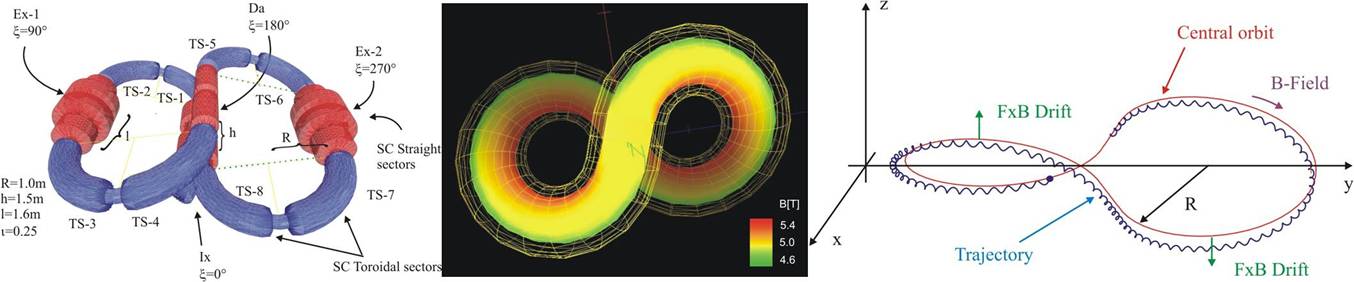 Left: Stellartor type Storage Ring, Middle: Simulated magnetic
surface, Right: Single particle trajectory
Left: Stellartor type Storage Ring, Middle: Simulated magnetic
surface, Right: Single particle trajectory
|
|
|
|
|
|
|
|
|
|
|
|
|
|
|
|
Diagnostics |
|
|
|
|
|
|
|
|
|
|
The ion beam diagnostics is one of the challenging topics. There exist various
methods destructive and non destructive. Ion beam profile using rest gas
interaction is one of the ways to acquire beam profile. Efforts were made in past
to construct transversal profile of the beam by arranging CCD camera radially to
acquire beam image and reconstruct beam profile commonly known as tomography.
There has been recent development at University of Frankfurt on this subject.
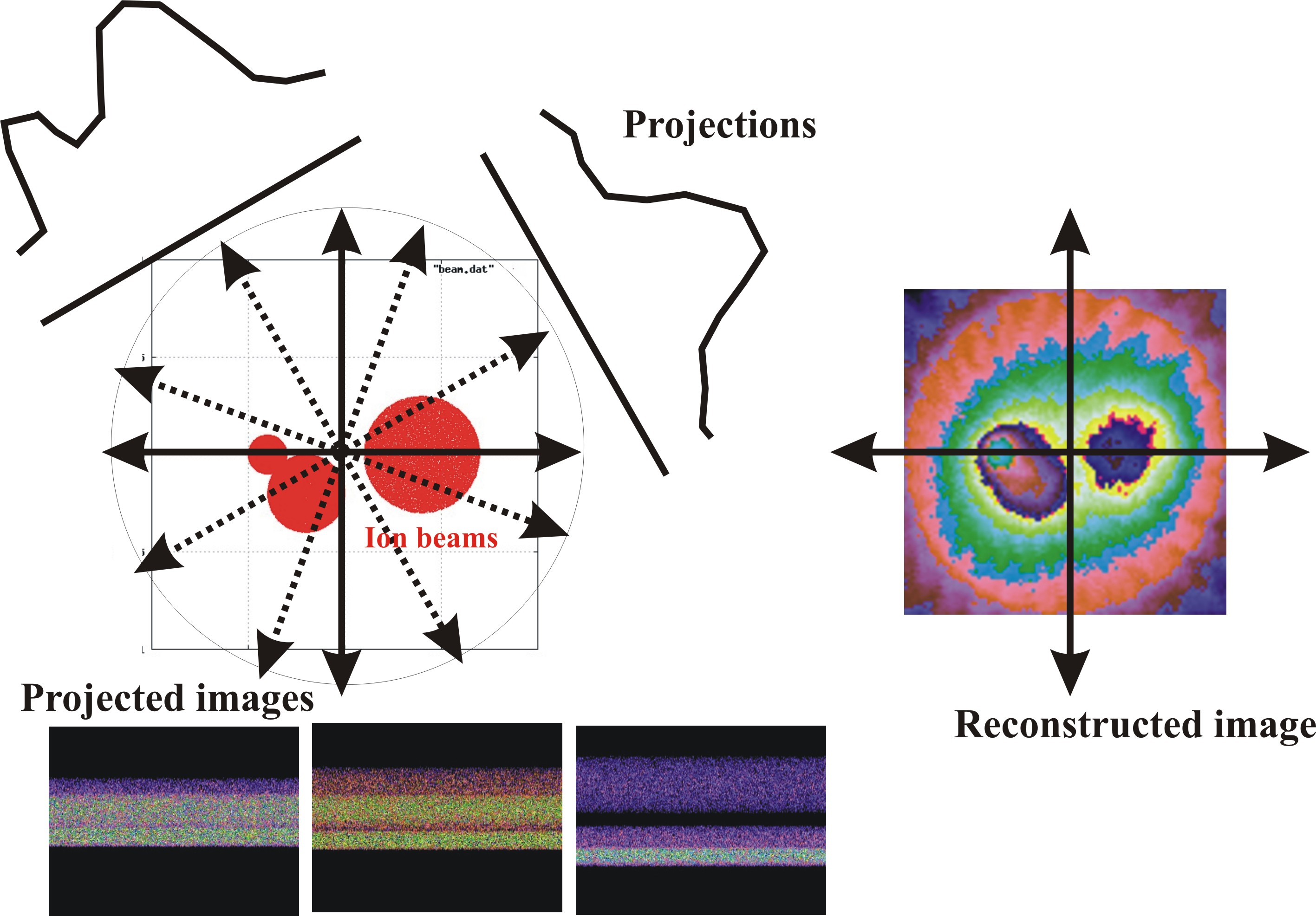
Tomographic reconstruction of ion beam in transversal plane
The beam transport experiments in curved magnetic field, indicated necessity for
unconventional type of diagnostics. I proposed for a ring device consisting
photodiodes can be used to determine transversal beam profile. A circular ring with
series of photodiodes was constructed and analyzed under a context of Bachelor
thesis (Adem Ates, Uni. Frankfurt). The experimental results were shown to be in
agreement with simulations.
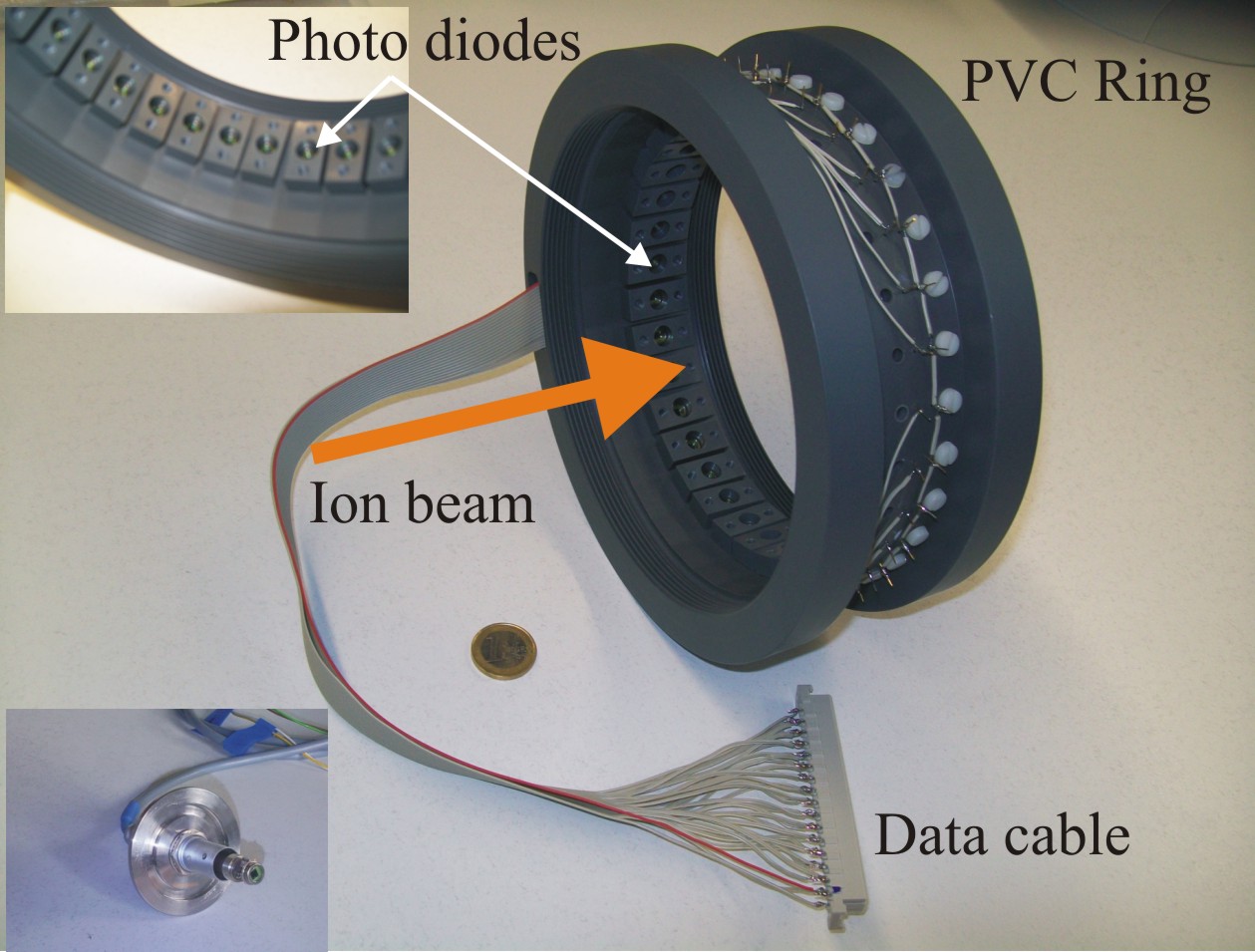
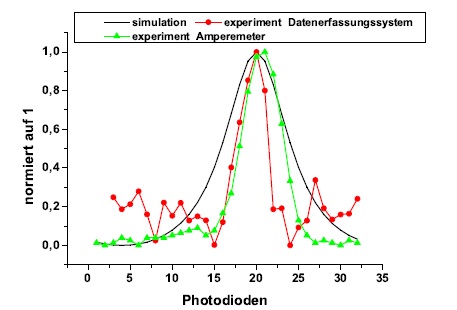
Left: Ring with Photodiode, Right: Simulation and Measurements
compared
|
|
|
|
|
|
|
|
|
|
|
|
|
|